Ticks might be tiny, but they can pose a surprisingly significant risk to both pets and people. These small external parasites are commonly found in long grass, woodland and areas frequented by wildlife such as deer and hedgehogs, which means your dog or cat could encounter one without you even realising.
The good news is that with regular checks and appropriate preventative treatment, you can help protect your pet from ticks and the diseases they may carry.
What are ticks?
Ticks are small parasites that attach themselves to animals, and sometimes people, to feed on blood. Before feeding, a tick can be very small and difficult to spot. Once attached, however, it can remain on your pet for several days and gradually become larger as it feeds.
In the UK, ticks tend to be most active during spring and autumn, but they can be encountered throughout the year, particularly during periods of mild weather.
Dogs that regularly explore woodland, fields, long grass and other countryside environments may be particularly likely to pick up ticks. However, ticks aren’t exclusively a countryside problem, so checking your pet regularly is a good habit wherever you live and walk.
Why are ticks a concern?
The tick itself can cause irritation where it attaches, but the bigger concern is that some ticks can carry and transmit infections.
One of the best-known is Lyme disease, a bacterial infection that can affect dogs as well as humans. Not every tick carries Lyme disease, and finding a tick on your pet doesn’t automatically mean they will become unwell, but it’s important to be aware of the potential risk.
Possible signs of Lyme disease in dogs can include:
- Lethargy or seeming unusually tired
- A high temperature
- Swollen or painful joints
- Lameness, which can sometimes appear to move between legs
- Reduced appetite
Signs can develop in the weeks following a tick bite, although in some cases they may take considerably longer to appear.
If you’ve recently removed a tick from your pet and notice a change in their health or behaviour afterwards, please contact us for advice.
How to check your pet for ticks
Regular tick checks are one of the simplest things you can do, particularly after walks through woodland, fields or long grass.
Run your hands slowly over your pet’s body and feel for any unusual small bumps. Pay particular attention to areas such as the:
- Head and face
- Around and inside the ears
- Neck
- Legs and feet
- Armpits and groin
- Areas underneath collars or harnesses
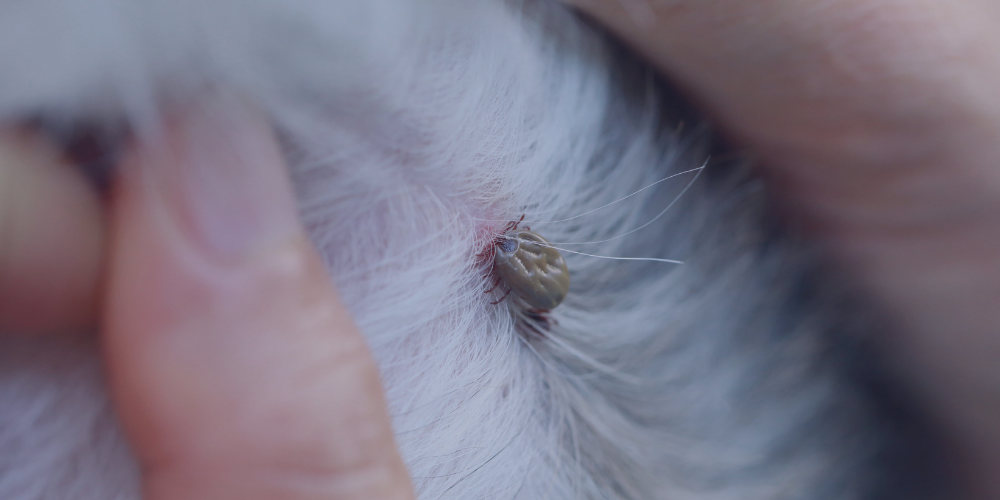
A newly attached tick may look like a tiny dark speck and can easily be mistaken for a small scab. As it feeds, it becomes larger and may look like a smooth grey or brown lump attached to the skin.
I’ve found a tick, what should I do?
If you discover a tick attached to your pet, it is important to remove it correctly.
Avoid simply pulling at the tick with your fingers or squeezing its body. Doing so can result in parts of the tick being left behind in your pet’s skin and may increase irritation.
Instead, you can either use a purpose-designed tick removal tool, following the instructions carefully to remove the whole tick. Alternatively, if you’re unsure or don’t feel comfortable removing it yourself, contact us, and our team will happily do this for you.
After removal, keep an eye on the area and on your pet’s general health.
Prevention is better than cure
Although checking your pet is important, preventative parasite treatment offers another valuable layer of protection.
There are several different types of tick treatment available, and the most appropriate option will depend on your pet’s species, age, lifestyle and individual health needs.
This is one reason we recommend speaking with our team rather than simply choosing a parasite product yourself. Some products designed for dogs can be highly toxic to cats, for example, so it’s essential that treatments are used only for the species for which they are intended.
We risk-assess each pet to ensure they receive the treatment appropriate to them and their lifestyle, and also with the environmental impact in mind. Our team can help you choose an appropriate treatment while considering your pet’s individual parasite risk.
Make parasite protection easier with our Pet Health Clubs – something for everyone!
Keeping on top of parasite prevention can be easy to forget. Treatments may be needed throughout the year, and your pet’s requirements can change as their lifestyle, age and health change.
That’s where our Pet Health Clubs can help. We have three levels of Health Club:
Our Health Plans are designed to make routine preventative healthcare simpler and more manageable, helping you stay one step ahead when it comes to protecting your pet.
Rather than waiting until you find a tick or another parasite, you can take a proactive approach to your pet’s health, with preventative care planned throughout the year.
Joining one of our health clubs can also help you spread the cost of your pet’s routine preventative healthcare, giving you one less thing to remember and helping your pet receive the protection they need at the right time. They are also filled with a whole host of other benefits!
Protect them before parasites become a problem
Ticks are easy to miss, but prevention doesn’t have to be.
Speak to a member of our team to find out more, or visit the Pet Health Clubs section of our website.