How did your pet cope with Bonfire Night?
For many of us, fireworks are a highlight of the celebrations, but for our pets, the sudden bangs, bright flashes and unfamiliar noises can be frightening. If your dog spent Bonfire Night trembling behind the sofa or your cat disappeared into their favourite hiding place, you’re certainly not alone!
With New Year’s Eve fast approaching, now is the ideal time to think about how your pet coped earlier this month, and what you can do to make the next round of celebrations a little less stressful.
We understand just how distressing firework anxiety can be for pets and their owners. Thankfully, there are plenty of ways we can help.
Recognising the signs of firework anxiety
Not all pets show their fear in the same way. While some become visibly distressed, others display much more subtle signs of anxiety.
Common signs include:
- Trembling, shaking or excessive panting
- Pacing, restlessness or an inability to settle
- Hiding, withdrawing or seeking constant reassurance
- Barking, whining or excessive vocalisation
- Drooling, lip licking or repeated yawning
- Refusing food or treats
- Trying to escape or scratching at doors and windows
- Toileting indoors unexpectedly
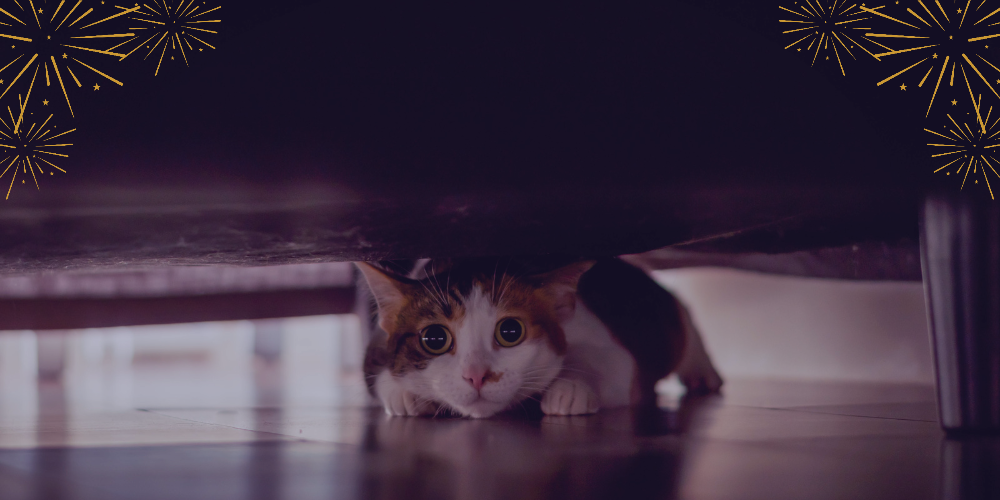
Cats may become particularly withdrawn, hiding away for long periods, eating less or avoiding their usual routines.
It’s important to remember that these behaviours aren’t your pet being difficult. They are genuine signs of fear, and even pets who have previously coped well with fireworks can develop noise sensitivities as they get older.
How can you help your pet at home?
A little preparation can make a big difference to how your pet experiences New Year’s Eve.
Create a safe, cosy retreat
Provide a quiet, comfortable space where your pet can escape from the noise. This might be a covered crate for a dog who already enjoys using one, or a favourite hiding spot for your cat. Add familiar bedding, a toy, and allow them to come and go freely.
Keep the noise and flashes out
Close curtains and blinds before it gets dark, and turn on the television, radio or some calming background music to help mask the sound of fireworks. Classic FM offers a wonderful pet channel, and YouTube also has plenty of options targeted specifically at pets frightened of fireworks.
Plan walks and outdoor time carefully
Walk dogs earlier in the day, well before fireworks are likely to begin, and keep them securely on a lead when outside. Make sure cats are safely indoors before dark, with access to a litter tray. This will not only ensure that you don’t accidentally get caught out walking whilst the fireworks are taking place, but will also mean your pet is nice and tired to settle in for the evening.
Offer comfort and reassurance
If your pet comes to you for reassurance, it’s absolutely fine to comfort them. You won’t reinforce their fear by offering affection. Equally, if they prefer to hide, let them have their space.
Try calming activities
Food puzzles, lick mats and favourite chews can provide a welcome distraction for some dogs. However, if your pet is too frightened to engage, don’t force them.
Check their identification
Frightened pets can sometimes bolt unexpectedly. Make sure your pet’s microchip details are up to date and that dogs are wearing a collar with an identification tag.
What veterinary help is available?
If your pet struggled during Bonfire Night, you don’t have to simply hope they’ll cope better next time.
Veterinary medicine has made significant advances in managing noise-related anxiety, and there are now several options available to help pets who find fireworks particularly frightening. If you have any concerns, chat with our team, who will be happy to provide tailored advice for you and your pet.
Prescription anxiety medication
Modern veterinary medications can help reduce the fear and anxiety associated with fireworks, rather than simply making pets sleepy. Some treatments are specifically designed for dogs with noise phobias, while other options may be appropriate for cats experiencing acute anxiety.
Our team can assess your pet’s individual needs and recommend a suitable treatment, including when and how it should be given.
Calming supplements and pheromone products
For pets experiencing milder anxiety, calming supplements and species-specific pheromone products may provide additional support. These can be particularly useful when introduced as part of a wider plan to help your pet feel more secure.
Behavioural support
For pets with established firework phobias, longer-term behavioural support can also make a real difference. Gradual desensitisation using carefully controlled firework recordings, alongside positive reinforcement, can help some pets become more comfortable with unfamiliar sounds over time.
This process should be introduced well away from firework season and at a pace your pet can comfortably manage. Our team can advise on suitable behavioural support.
Don’t wait until New Year’s Eve
One of the most important things to remember is that planning ahead gives your pet the best chance of coping.
Some anxiety treatments work best when given before the fireworks begin, and certain medications may need to be trialled in advance to ensure they’re suitable for your pet.
If your pet was frightened during Bonfire Night, now is the perfect opportunity to speak to us about preparing for New Year’s Eve.